

Controlling where your money goes when you pass
Where your money goes when you pass is not only a will question. It is also an accounts question, a forms question, and sometimes a trust question. Families get surprised when those pieces do not match.
Start with how the asset is owned
Retirement accounts and many insurance policies often pass by beneficiary form. That form can override what a will says for that account. Out of date forms are one of the most common reasons money goes somewhere you did not intend.
Trusts and wills handle a different path. Assets titled to a trust, or directed through an estate plan, are distributed by the trustee or personal representative following your instructions.
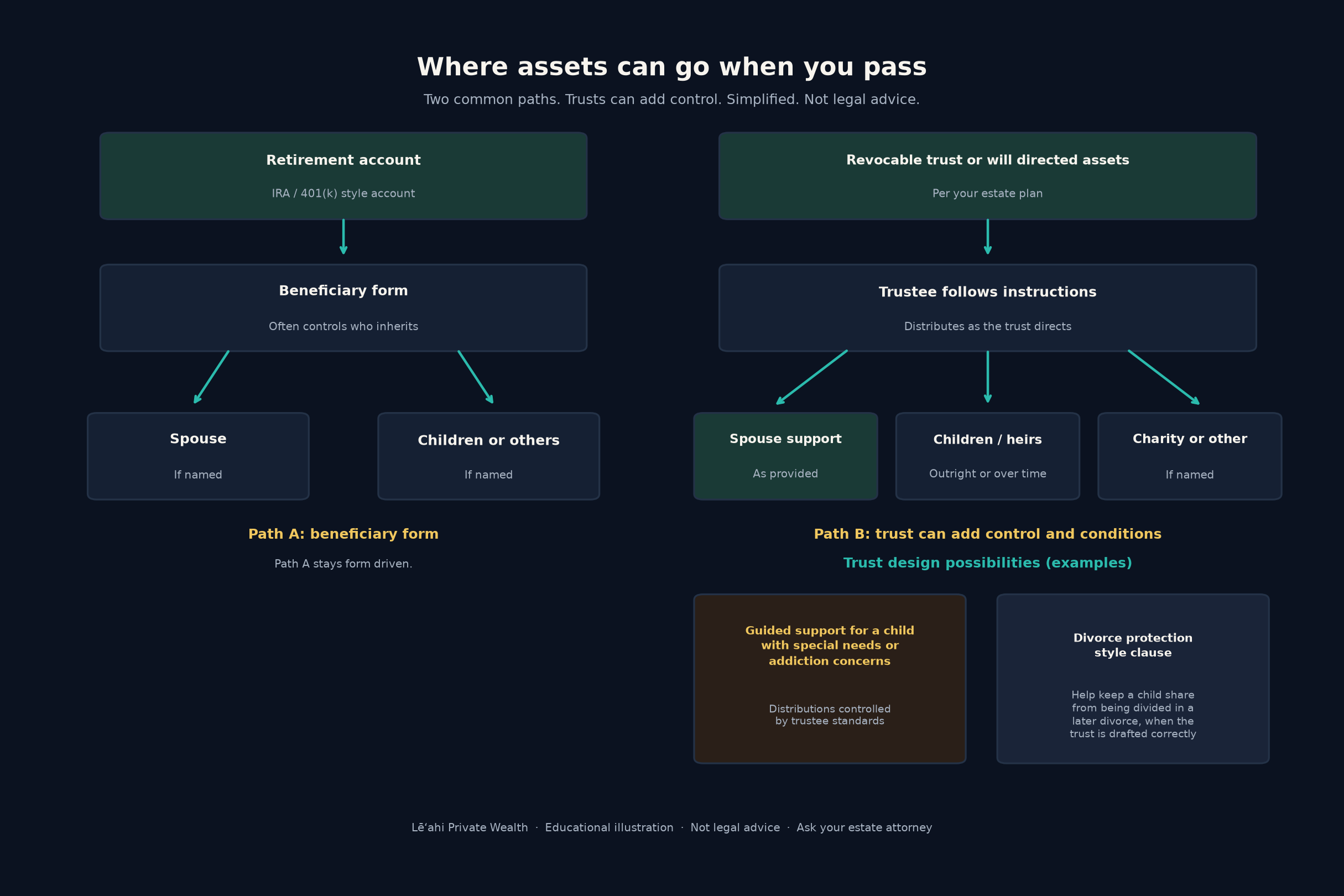
Caption: Two common paths. Path A is form driven. Path B uses a trust or estate plan. Not legal advice.
Beneficiary designation vs trust, in plain English
A beneficiary designation is usually fast and account specific. Name who should receive that account. Keep the form current after marriage, divorce, births, deaths, and major account changes.
A trust can add control. Instead of an outright check to an heir, a trustee can follow rules you set. That can matter when you want support over time, protection for a vulnerable heir, or clearer handling of family complexity.
Trust design possibilities
Some trusts include guided support for a child with special needs or addiction concerns, with distributions controlled by trustee standards.
Some trusts include divorce protection style clauses meant to help keep a child share from being divided in a later divorce, when drafted correctly.
These are examples, not templates. Your attorney should draft language that fits your family and state law.
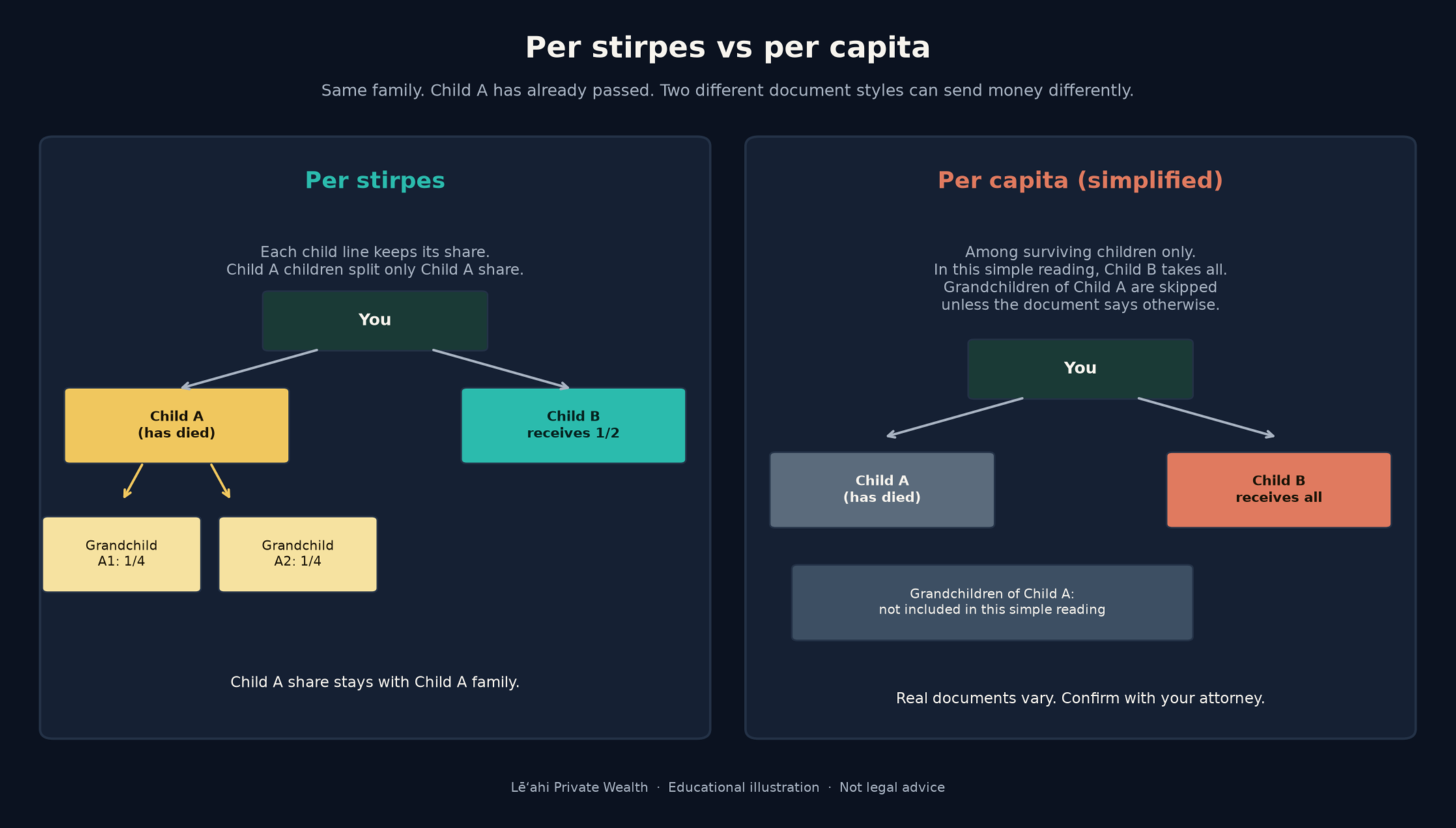
Caption: Per stirpes vs per capita, simplified. Confirm your forms with your estate attorney.
Per stirpes and per capita
Documents often use labels that decide who inherits if someone in the family has already passed.
Per stirpes usually means each child line keeps its share. If a child has died, that child share often goes to that child descendants.
Per capita language can work differently. In a simple reading among surviving children, a deceased child share may not pass to grandchildren the same way. Exact results depend on the document. Do not assume. Confirm the wording.
What we help with
We help organize beneficiary strategy, account structure, and wealth transfer goals inside your wider financial plan. We do not draft legal documents. We coordinate with your estate planning attorney so investments and estate intent line up.
FAQ
Does my will control my IRA?
Often the beneficiary form controls that account. Forms and documents must be reviewed together.
When should I update beneficiaries and estate instructions?
After any major life event, and on a regular review schedule even when life feels quiet.
Author
Christian Park, Managing Advisor, Lēʻahi Private Wealth
Educational information only. Not legal, tax, or personalized investment advice. Please consult your estate planning attorney. Advisory services offered through Kingswood Wealth Advisors (KWA), an SEC registered investment adviser. Securities services offered through Kingswood Capital Partners, LLC (KCP), member FINRA/SIPC.